Backend Developer Vacancy Roundup: 7 Openings for 2026

You've opened another backend developer vacancy, and it looks almost identical to the last one. There's a language list, a remote label, and a description of an ambitious engineering team. What you still can't tell is whether you'll own payment services, maintain internal APIs, or spend most of your time operating infrastructure.
The seven entries below are starting points for finding roles, each with different strengths in stack visibility, compensation disclosure, employer context, and application routes. One is a specific Bitrefill vacancy; the other six are platforms where backend roles surface with uneven signal quality. Read each listing through a hiring lens: stated stack, seniority, pay visibility, posting freshness, and the interview loop it implies.
The useful question isn't which board has the most results. It's which source helps you identify work you can demonstrate, at a level you're ready to own. Keep your outreach equally focused: the recruiter outreach tips from DMpro offer context for understanding how recruiters approach candidates. Before investing in an application, establish the stack, employment arrangement, posting date, and destination of your application.
1. Backend Developer at Bitrefill
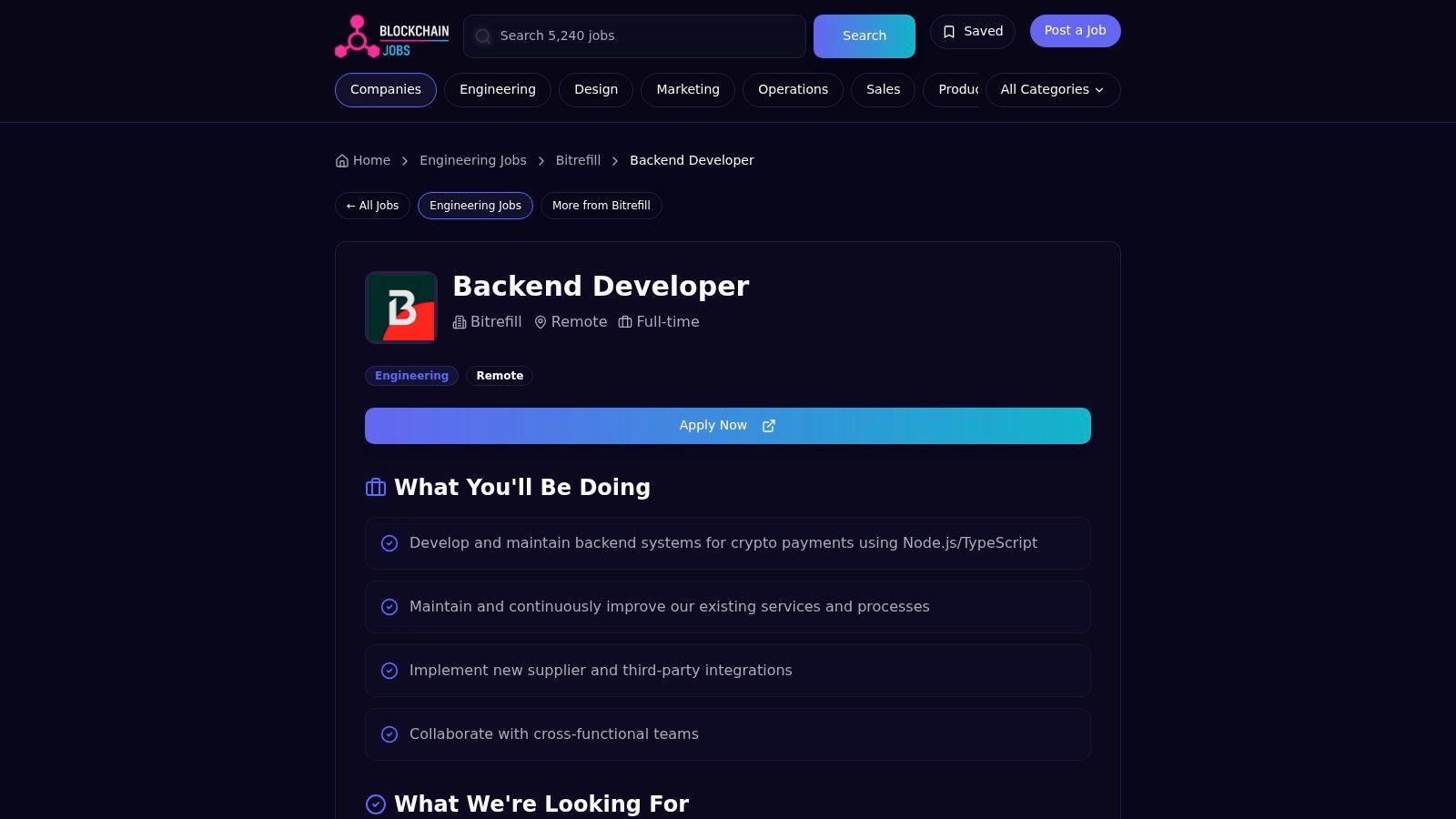
The Backend Developer at Bitrefill listing describes a full-time, fully remote role building crypto-payment technology. Its stated stack includes Node.js and TypeScript and/or Python, alongside MongoDB and Typesense. That makes it a focused option for engineers who want a practical Web3 application rather than an unspecified blockchain project.
The important qualification is the wording around languages. Don't assume you must be equally strong in Node.js and Python, or that either language alone guarantees a match. Confirm which services the successful candidate will maintain and whether the team expects immediate production ownership.
What to verify before applying
- Scope and language preference: Ask whether the work centers on payment APIs, integrations, background processing, search, or another service boundary.
- Compensation and level: The available preview doesn't specify salary, benefits, or seniority. Establish these before committing to a substantial assessment.
- Remote eligibility and freshness: Confirm eligible locations, working-hour overlap, and whether the position is still accepting applications.
The advantage is technical specificity. MongoDB and Typesense give you concrete preparation targets: data modeling, indexing, search synchronization, and recovery when a downstream service fails. The trade-off is incomplete employment information, so use the backend developer salary guide to frame compensation questions, not as proof of this role's pay.
For interview preparation, build a payment-processing scenario with idempotent requests, explicit state transitions, retry handling, and reconciliation. Explain how you'd prevent a repeated webhook from producing a duplicate action and how operators would investigate an inconsistent transaction.
Interview priority: Demonstrate correctness when dependencies fail, not just a successful API response.
Those are preparation recommendations, not confirmed Bitrefill interview topics. Ask about on-call duties and custody boundaries, too: payments experience can support career progression toward service ownership, but the actual responsibilities determine whether this vacancy offers that path.
2. Web3.career
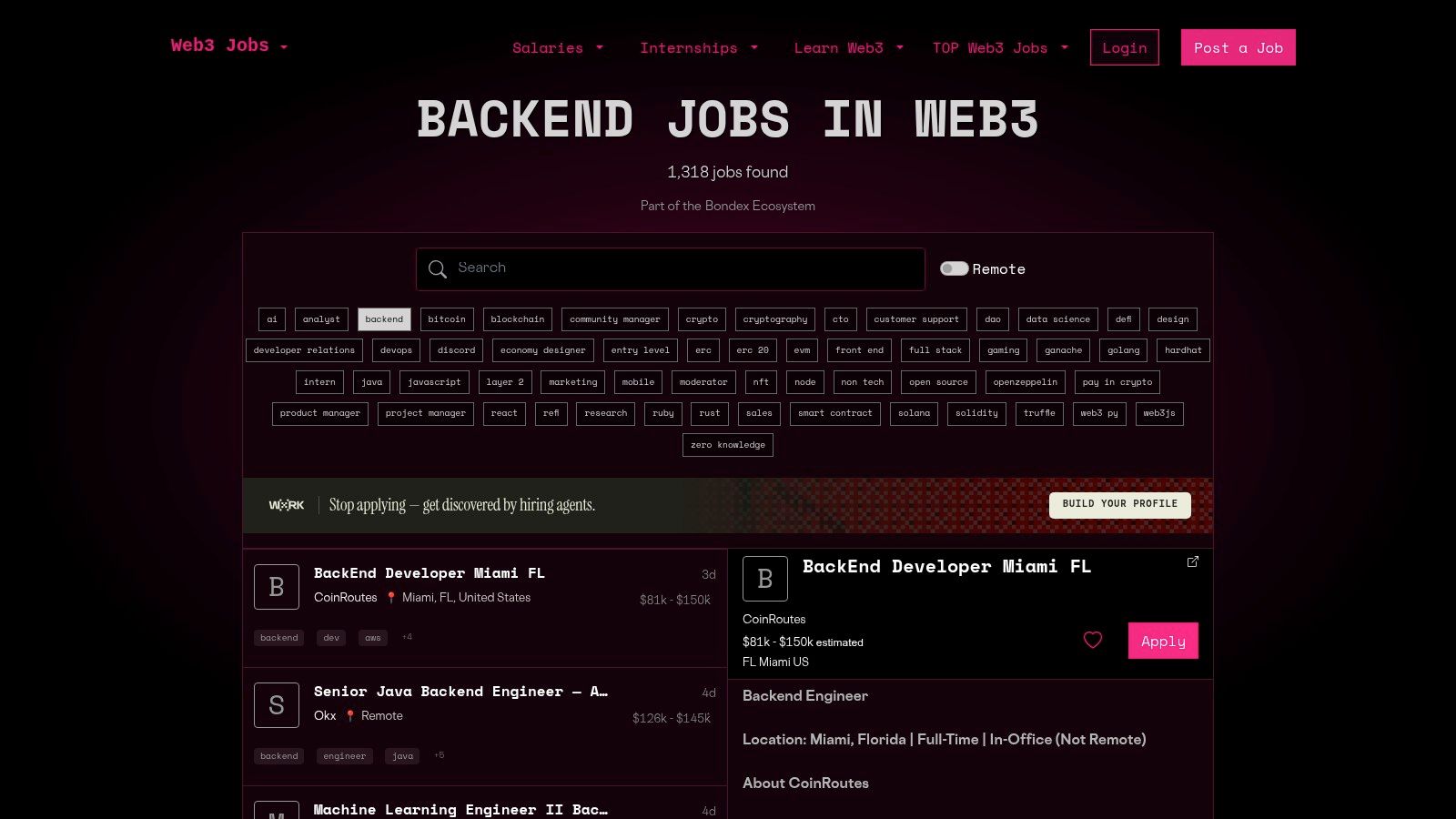
Start with Web3.career's backend jobs page if blockchain or crypto experience is central to your next role. Its dedicated backend searches can surface blockchain, DeFi, and related positions, including U.S.-based and remote opportunities. Technology and domain tags such as Bitcoin, Java, and Go help you separate relevant services from loosely related engineering work.
Some listings show salary ranges and posting dates, but disclosure isn't universal. Treat tags as navigation aids rather than complete requirements, and verify seniority in the responsibilities rather than inferring it from the title.
Distinguish protocol work from application work
A Go vacancy might involve transaction infrastructure, an exchange service, or an ordinary application API. Read for concrete ownership signals: RPC integration, indexing, signing, node operations, and handling chain reorganizations imply different preparation from account management or reporting endpoints.
This distinction matters for your portfolio. An ACM analysis of blockchain-engineering vacancies found systems languages such as Rust and Go appearing alongside higher-level languages, with nearly half of postings referencing deployment or cloud capabilities. Prepare deployment configuration, health checks, and incident recovery alongside your application code.
The strength is sector relevance; the limitation is variable coverage and freshness. A remote label doesn't establish U.S. eligibility, and an older listing may no longer represent an active hiring process. Check the employer's application page before tailoring your resume.
Use the Web3 job board guide to compare specialist search options. For interviews, prepare a chain-integration example that explains finality assumptions, duplicate events, and recovery after an interrupted indexing process.
3. LinkedIn Jobs
LinkedIn Jobs is useful when you need job discovery and employer context in the same workflow. Search backend developer, backend engineer, and stack-specific titles, then filter by location, experience, employment type, and recency. Company pages and professional profiles can help you understand the team behind an otherwise generic advertisement.
Its breadth is also the drawback. Results can include full-stack positions, recruiter advertisements, and jobs whose backend duties are secondary. A large result count isn't evidence that the vacancies are current or appropriate.
- Stack signals: Search a language alongside a responsibility, such as Java payments or Python platform, rather than relying on backend alone.
- Pay and seniority: Check the individual description. An experience filter doesn't establish the employer's actual expectations or compensation.
- Application route: Identify whether you're applying through LinkedIn, an external applicant system, or a staffing firm.
- Freshness: Use recency filters, then confirm that the employer still lists the position.
Use networking to resolve ambiguity
A focused message to an engineer or recruiter should ask something the description doesn't answer. Ask whether the team owns deployments, how service boundaries are divided, or whether the opening replaces an existing engineer or expands the team.
A useful connection request explains why the work fits your experience. It doesn't ask a stranger to endorse skills they haven't evaluated.
For interview preparation, connect your examples to the employer's product. An authorization service, billing platform, and analytics pipeline require different discussions even when all use Java.
The guide to job boards for engineers can help you decide where LinkedIn belongs in your broader search. Keep it for coverage and context, not as your only source of qualified opportunities.
4. Wellfound
A startup backend role can offer broad ownership or leave you maintaining everything without adequate support. Wellfound's backend-engineer search helps you investigate that distinction through startup profiles, company size and stage information, and individual role details.
Where employers supply them, salary and equity disclosures make initial screening more useful. Location and remote-work details also help, but you still need to confirm geographic eligibility. Some visible positions may be older, so check the posting date and employer application page before spending time on a customized submission.
Evaluate the operating environment
Read the stack against the company's stage. A small team seeking API development, database administration, deployment ownership, and incident response may be hiring its principal backend operator, even if the title sounds narrower.
- Ownership: Ask who reviews architecture and who shares production support.
- Compensation: Separate cash salary from equity, and ask how the equity offer is expressed and documented.
- Career progression: Establish whether growth means deeper technical ownership, team leadership, or increased responsibilities.
- Interview preparation: Bring an example where you chose a simpler system because the team couldn't justify operating a more complex one.
Wellfound's advantage over a general board is startup context, not guaranteed transparency. Company profiles can help you identify questions, but they don't replace direct discussion of engineering staffing, business priorities, or support expectations.
For an early-stage interview, prepare to explain migrations, deployment safety, and pragmatic security controls without assuming a dedicated platform team. Don't present microservices as the automatic answer. A well-structured application with clear boundaries and a credible scaling path can demonstrate better judgment than an architecture the employer can't maintain.
5. Dice
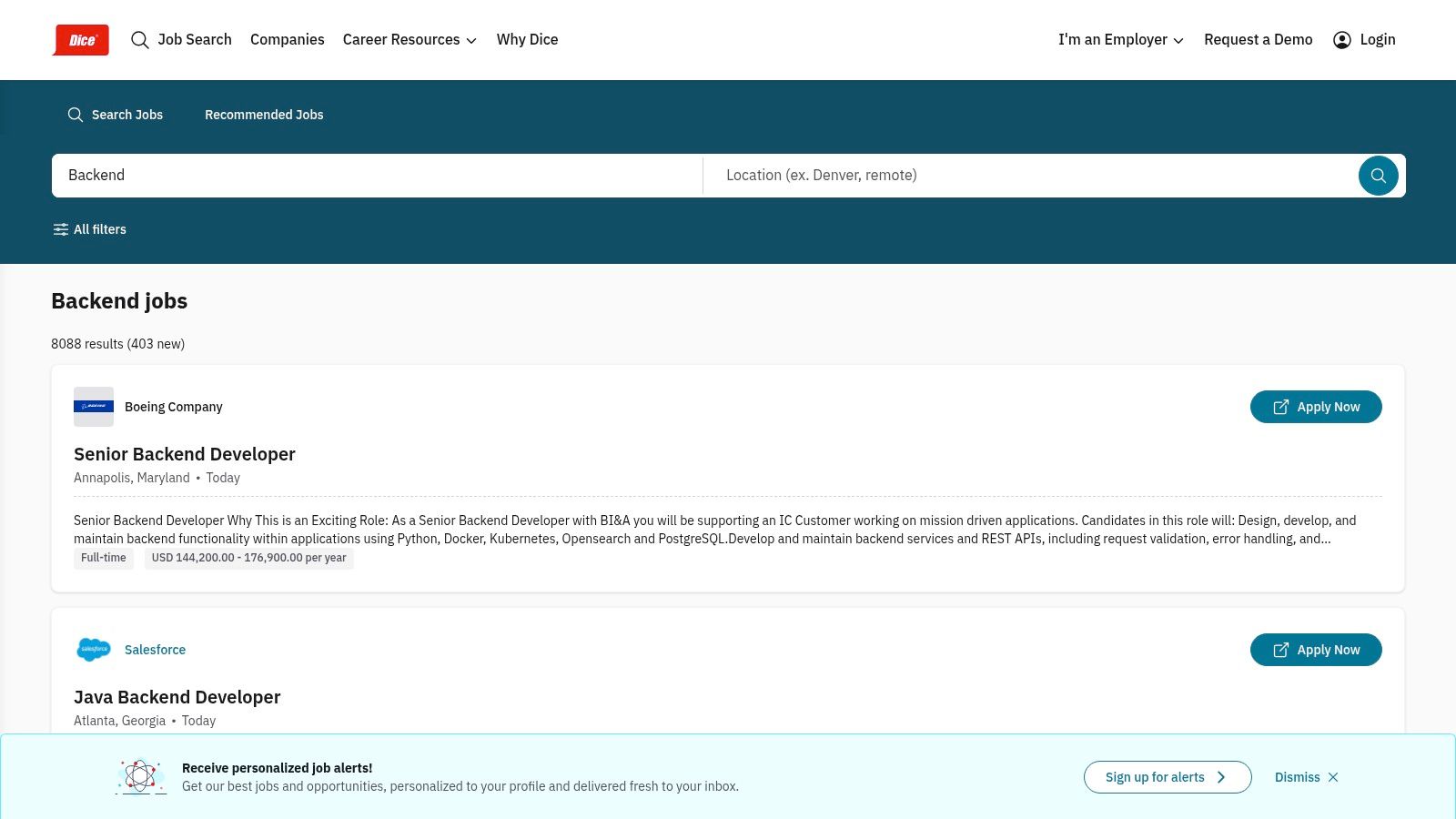
Contract versus permanent employment should be an early filter on Dice, not a late discovery. Its technology-focused searches can surface Java, Python, and backend software-engineering positions across permanent and contract arrangements. Remote and hybrid roles may appear alongside salary or hourly compensation.
Skill-specific searches are useful when you know your strongest stack. They're less useful if you accept every keyword match: a Python result might concern automation or data work rather than ownership of backend application services.
Read the engagement before the stack
Some advertisements come from staffing firms or intermediaries. Establish who employs you, who directs the work, and which organization runs the interview before agreeing to representation.
- Employment terms: Verify contract duration, extension expectations, benefits, and any stated conversion arrangement.
- Location and eligibility: Review work authorization, client-site requirements, and whether remote work has geographic restrictions.
- Role boundaries: Identify whether you'll design services or primarily implement tickets within an established architecture.
- Compensation: Don't compare an hourly figure with a salaried offer without considering paid leave, benefits, and unpaid gaps.
Dice's strength is access to technical engagements that may not suit a startup-focused platform. Its weakness is that intermediary listings can leave the employer context or project scope unclear.
For interviews, prepare examples of entering an unfamiliar codebase: tracing request flow, identifying missing tests, reproducing a defect, and releasing a safe change. Contract opportunities can be useful for deepening a stack specialization, but ask whether the assignment includes architectural responsibility if that's your next career step.
A technically suitable backend developer vacancy can still be the wrong move when its employment terms don't fit your needs.
6. Built In
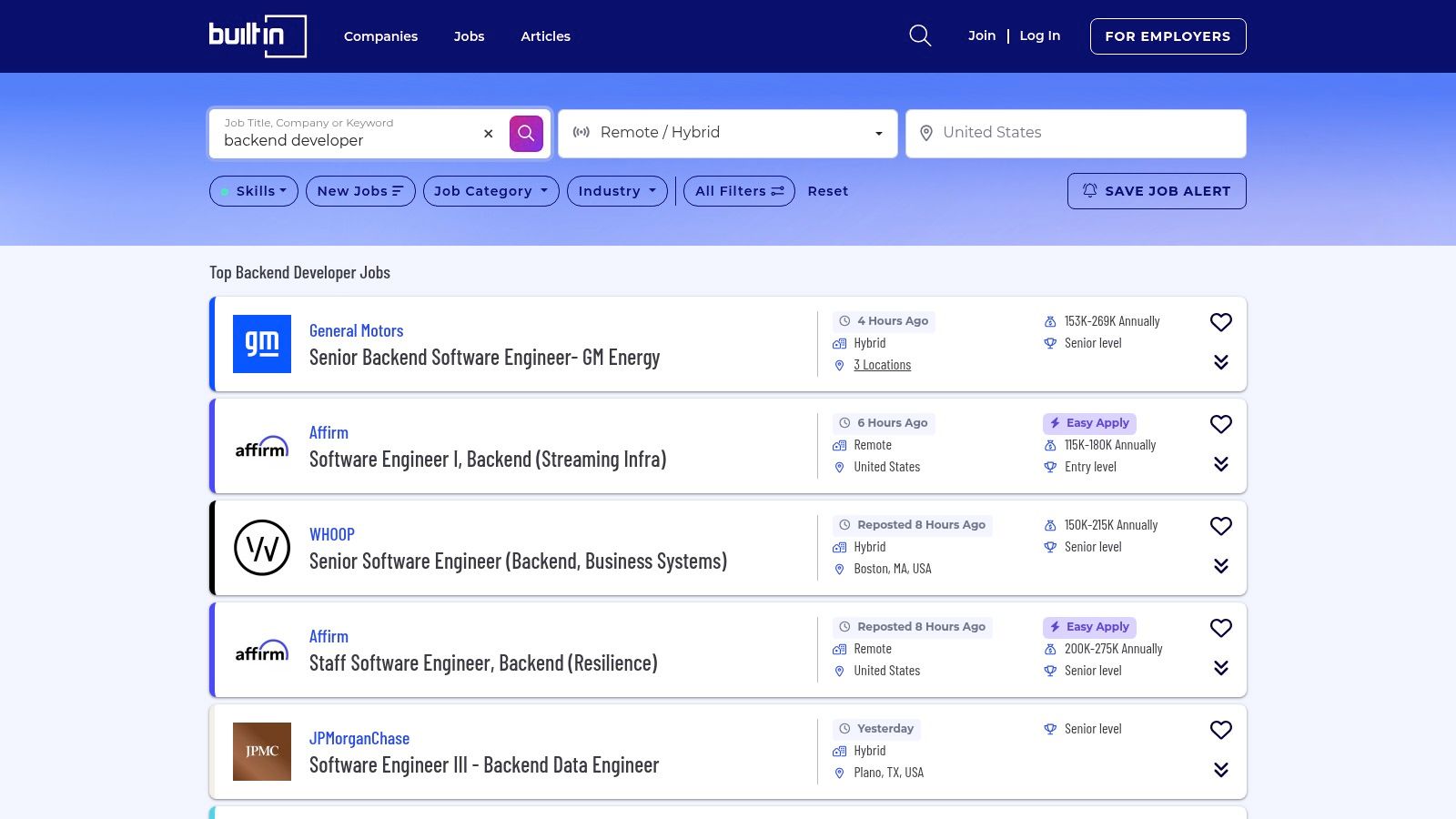
Built In's backend-developer search is useful for comparing technology-company opportunities alongside company context. Individual listings may expose compensation, seniority, requested skills, and industry information. Remote U.S. browsing can help narrow the search, although each role's location requirements still need inspection.
The practical advantage is comparison. You can review the advertised level, technology requirements, and employer profile together rather than collecting those details across unrelated pages. Coverage may be narrower than on the broadest national platforms, and disclosure varies by employer.
Compare ownership, not title prestige
A senior backend role should involve more than familiarity with a longer tool list. Look for responsibility for service design, data correctness, production reliability, technical decisions, and support for other engineers.
HackerRank's 2025 Developer Skills Report reported year-over-year hiring-activity increases of 22% for lead developers and 19% for senior developers. That's a reason to make your ownership evidence explicit, not to assume every senior-labeled vacancy has the same expectations.
Career filter: Prefer a role whose responsibilities explain how you'll grow over one whose title merely sounds more advanced.
Before applying, check whether a remote result requires office attendance or residence in a particular location. Confirm that the employer's application destination remains active, and distinguish a published salary range from an amount you can expect to receive.
For interview preparation, build a concise account of a service decision: the constraints, alternatives, failure risks, rollout, and operational consequences. If the vacancy emphasizes reliability, bring monitoring and rollback reasoning rather than another framework demonstration.
Built In works best when you're choosing among technology employers, not collecting every possible backend match.
7. Indeed
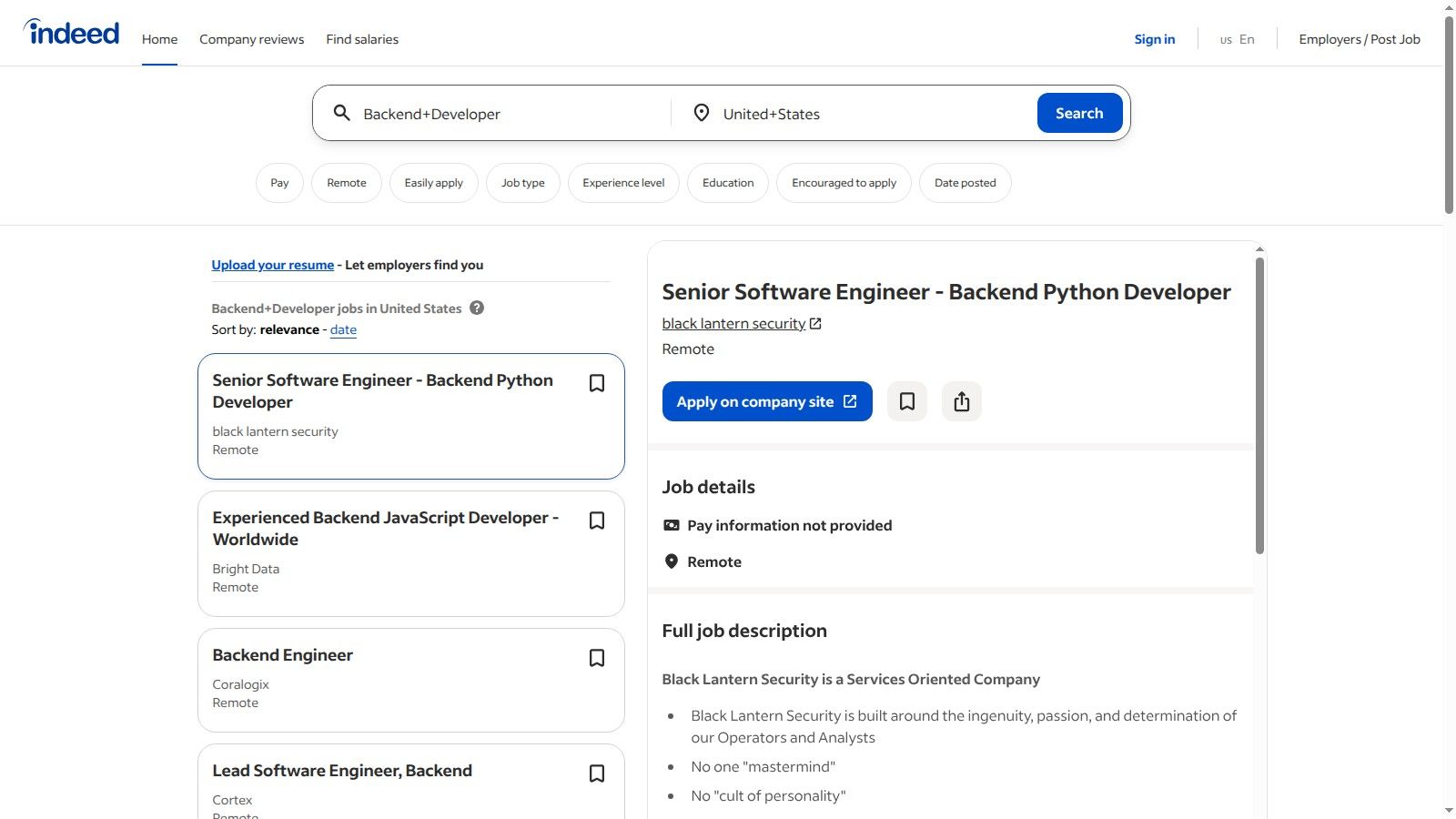
Use Indeed's U.S. backend-developer search when you want coverage beyond crypto-native companies and familiar technology brands. Its broad employer reach can help you find local, remote, and hybrid opportunities across different organization types.
Search filters cover remote work, pay, employment type, experience, and posting date. Some advertisements disclose compensation and benefits, while applications may stay on Indeed or move to the employer's website. Resume upload and alerts support an ongoing search, but neither removes the need to qualify each result.
- Relevance: Read the actual duties for API ownership, database work, background processing, and production support.
- Employer identity: Separate direct hiring from staffing-agency advertisements and verify the application destination.
- Freshness: Watch for reposts and confirm that the employer's original vacancy remains available.
- Disclosure: Treat missing salary, seniority, or work-arrangement details as unresolved questions.
Prepare for judgment, not just code generation
General searches expose you to varied interview formats, so ask whether AI tools are permitted before beginning an assessment. Prepare to explain your own design and verification decisions regardless of the policy.
The 2025 Stack Overflow Developer Survey found that 84% of respondents use or plan to use AI tools, while 51% of professional developers use them daily. Familiarity alone won't distinguish your application; demonstrate how you review generated code, test authorization boundaries, and validate database changes.
Indeed's strength is breadth. Its weakness is the manual screening needed to remove loosely matched duties, duplicate advertisements, and unsuitable arrangements. Keep alerts narrow enough that you can investigate matches rather than accumulate unread notifications.
How the seven backend developer vacancy sources compare on arrangement, pay visibility, and best use
Arrangement and pay disclosure are the two fields that decide whether a listing deserves your time, so read each row as a screening shortcut rather than a ranking. Sources that publish salary let you qualify a role before applying; sources that do not push that question into the recruiter conversation, where it costs you a round of back and forth.
| Item | Work Arrangement | Salary Visibility | Best For |
|---|---|---|---|
| Backend Developer at Bitrefill | Full-time, fully remote | No salary figure published on the listing | Backend engineers interested in crypto payments |
| Web3.career | U.S. and remote roles | Shown on some listings | Developers targeting blockchain and Web3 roles |
| LinkedIn Jobs | Remote, hybrid, and on-site roles | Shown on some listings | Broad job searches with networking and company research |
| Wellfound | U.S., remote, and international startup roles | Salary and equity shown on some listings | Candidates interested in startups |
| Dice | Remote, hybrid, and on-site arrangements | Salary or hourly pay shown on some listings | Technical candidates seeking permanent or contract roles |
| Built In | Includes remote U.S. roles | Compensation shown on some listings | Candidates comparing technology companies and roles |
| Indeed | Local, remote, and hybrid roles | Pay included on some listings, absent on others | Candidates seeking a broad range of backend openings |
Two patterns matter here. Specialist sources give you fewer results but clearer stack signals, so a crypto payments listing tells you more about the work than a generic backend title on a broad platform. General platforms compensate with volume, which means the screening burden shifts to you. Where pay is unpublished, treat it as an open question to resolve in the first conversation, and check the posting date before investing interview prep in a role that may already be filled.
Turning a Backend Search Into a Repeatable Hiring Pipeline
Treat your search as a pipeline rather than a scroll. Choose two or three sources that fit your target stack and employer stage: a specialist Web3 board for sector relevance, a broad platform for coverage, and a startup-focused source if you want that operating environment.
Save the same screening fields for every vacancy: stack, pay disclosure, seniority, posting date, location eligibility, and application route. Record what you verified and what remains unknown. An attractive description shouldn't bypass those checks because the company's product interests you.
Convert repeated requirements into interview evidence
Prepare around responsibilities that recur across suitable listings. If employers repeatedly ask for distributed services, build an example that handles duplicate messages, partial failures, and recovery. If database ownership appears frequently, prepare to explain indexing decisions, migration safety, and consistency trade-offs.
- Discovery: Save the original listing and employer application destination.
- Qualification: Resolve missing compensation, location, and ownership details early.
- Preparation: Match each important requirement to a project, decision, or debugging example.
- Follow-through: Log application dates, recruiter conversations, assessments, and agreed next steps.
At Blockchain Jobs, our email alerts send new roles once a day, and our level filters help you track relevant seniority bands. Use those capabilities to keep discovery separate from preparation, so you aren't repeatedly checking the same pages while neglecting an upcoming interview.
Ask recruiters what an assessment measures, how long it should take, and whether AI assistance is allowed. Employers designing an exercise can browse hiring test use cases when deciding how to structure candidate evaluation.
Keep your career objective visible throughout the process. If you want to progress toward senior engineering, prioritize opportunities to own reliability, security, and technical decisions. A familiar language is useful, but the responsibilities you can credibly take on matter more than another matching keyword.
Find backend and infrastructure opportunities across the Web3 ecosystem at Blockchain Jobs. Filter for the working arrangement and level that fit your next move, then review each role's requirements before building a targeted application.