
Cryptocurrency Jobs Salary: 2026 Pay Ranges by Role

US blockchain developer base salaries typically range from $90,000–$130,000 for junior roles, $130,000–$170,000 for mid-level roles, and $150,000–$220,000 for senior roles. Your actual offer can look very different once you separate guaranteed pay from tokens, equity and location adjustments.
A cryptocurrency jobs salary search is useful for setting an initial target, but it isn't enough to decide whether an offer is competitive. The better question is how much compensation you can reasonably receive, when you can access it, and what responsibilities the employer expects you to own.
Crypto Salary Ranges by Role and Seniority
For US blockchain developers, published base-salary bands run from $90,000–$130,000 at junior level to $150,000–$220,000 at senior level, with mid-level compensation at $130,000–$170,000, according to the daily.dev blockchain-developer hiring guide. Use these figures to benchmark roles with comparable scope, not as a guarantee attached to a title.
Blockchain salary bands by role and seniority
| Role | Junior | Mid-level | Senior |
|---|---|---|---|
| Blockchain developer (US) | $90,000–$130,000 | $130,000–$170,000 | $150,000–$220,000 |
| Senior smart-contract engineer | Not reported | Not reported | $160,000–$250,000 |
| Zero-knowledge specialist | Not reported | Not reported | About $300,000 at the specialist upper end |
The specialist figures are reported compensation benchmarks. Treat them as total-compensation references unless an employer confirms how much is guaranteed cash. Tokens and equity can make a headline figure look higher while leaving its realized value uncertain.
A broader reference is the 2023 Pantera Capital compensation survey, which reports a global median base salary of $120,000 among more than 1,600 blockchain professionals across 77 countries and regions. That global figure and a US engineering range measure different groups. Use the median for broad context, not as a ceiling for a specialized US role.
Match the band to responsibility
Junior work is supervised work. A candidate might implement a narrowly scoped contract function, write tests and respond to review comments. Be ready to describe how you checked correctness and where a more experienced engineer guided the work.
A mid-level engineer should be able to take a feature from specification through implementation, testing and deployment. The useful measure is ownership: can a manager hand over a defined problem without directing every implementation decision?
Senior responsibility includes architecture and security decisions. Candidates should explain upgradeability choices, trust assumptions, failure modes and deployment controls. Years in the field alone do not establish senior scope. Show which decisions you owned and what you were accountable for.
Benchmarking rule: Match your evidence to the employer's expected responsibility before matching your title to a salary band.
Don't use engineering pay for unrelated functions
Engineering benchmarks do not provide a reliable salary target for product, marketing, legal or finance roles. A product manager responsible for an exchange launch and a protocol engineer implementing consensus changes have different responsibilities, so their compensation should not be compared as if their jobs were interchangeable.
For these functions, use the job board's salary filter to find listings with disclosed pay for the exact title. Compare the role's jurisdiction, scope and seniority, then record whether the stated range is base salary or a broader package.
Before negotiating, identify the developer band that best matches your demonstrated responsibility. Treat general developer ranges as base pay before tokens, equity or bonuses, and ask employers to separate guaranteed salary from variable or token-based compensation.
Which Specialties Pay the Most
Crypto's technical premium is best understood as payment for scarce, consequential expertise, not payment for using blockchain terminology. The Gate Research crypto employment report puts technical roles at more than half of crypto-industry jobs, including development, security auditing and systems architecture.
The Dragonfly compensation dataset summarized by CryptoRank covered approximately 85 companies and 3,400 employee or candidate observations collected in late 2024 and early 2025; engineering represented roughly two-thirds of the workforce, and only about 10% of positions were entry-level. Its reported compensation benchmarks include approximately $160,000–$250,000 for senior smart-contract engineers and up to about $300,000 annually for zero-knowledge specialists.
Follow the scarce skill, not the label
Those observations support a specialist premium, but they don't establish a complete salary ranking across every technical discipline. Evaluate the work in these categories:
- Protocol engineering: Distributed-systems knowledge matters when an engineer owns consensus behavior, network coordination or rollup infrastructure. Ask which component you'll control and what production failures you'll be accountable for.
- Smart-contract development: Security-critical execution requires more than Solidity syntax. Demonstrate contract design, testing, integration and an understanding of adversarial interactions.
- Security auditing: The differentiator is identifying exploit paths and explaining a defensible fix. A finding should connect a vulnerable assumption to a reproducible impact.
- Zero-knowledge cryptography: Proving systems, cryptographic primitives and compiler-related work require specialized knowledge. The upper-end benchmark is relevant only when the job requires that expertise.
There are no separate verified salary bands here for protocol engineering or security auditing. Check salary-filtered listings for those titles instead of borrowing the smart-contract range.
Turn projects into a negotiation argument
List the skills used in your last three projects. Separate application integration from protocol implementation, routine contract development from security-critical ownership, and cryptographic library usage from proving-system engineering.
Then choose comparison roles by that work. A compiler tooling engineer shouldn't accept a generic Web3 engineer benchmark without asking whether the employer has accounted for the specialty.
Keep trading compensation separate, too. The crypto trader salary guide addresses a different career track, where performance-linked pay needs its own analysis.
For specialist offers, request separate cash, token and equity figures. Don't let a large ownership headline substitute for an explicit cash benchmark.
How Location and Remote Work Change Pay
In a 2023 compensation analysis covering 49 crypto portfolio companies, US employers paid approximately 13% higher salaries on average than international employers, while their equity and token packages averaged approximately 30% higher. These figures compare employers by location across the roles analyzed. They do not establish a guaranteed premium for an individual candidate.
The same analysis found that companies commonly used local-market rates or geographic tiers. A role can be open to remote applicants internationally and still carry different compensation by location. Remote eligibility and pay location are separate terms of an offer.

Regional salary figures can look comparable while describing different groups. The figures below mix engineering-specific averages with averages for broader crypto roles, so they do not show what the same employee would earn after relocating.
| Region and group | Reported average |
|---|---|
| US and Canada, engineers | $177,653 |
| Europe, all crypto roles | $112,476 |
| Asia, all crypto roles | $100,000 |
| Asia-Pacific, engineers | About $98,000 |
These regional figures are reported in the 2023 compensation analysis. They are separate observations, not a controlled comparison of equivalent employees. Use them as context, not as a precise relocation adjustment.
Identify the employer's pay model
A single global band sets a consistent rate across eligible locations. Payroll access, benefits and work authorization may still limit where the company can employ someone.
Country or city tiers tie compensation to the employee's location. Ask whether the employer uses your residence, payroll jurisdiction or office assignment to select the tier.
A contractor rate needs adjustment before comparison with employee pay. Account for the cost of replacing benefits, funding unpaid leave and handling administration.
Remote describes where work happens. It does not guarantee location-independent pay.
Location also affects where candidates can find openings. New York has 851 roles on Blockchain Jobs, the site's highest city count, followed by San Francisco with 377 and London with 330. 4,171 of 6,934 listed jobs are remote, but that count alone does not establish which locations an employer will accept.
The remote cryptocurrency jobs guide can help distinguish work arrangement from location eligibility. Before investing in interviews, ask: Which pay zone applies to my location, and would my compensation change if I relocated?
Convert Every Offer Into One Comparable Figure
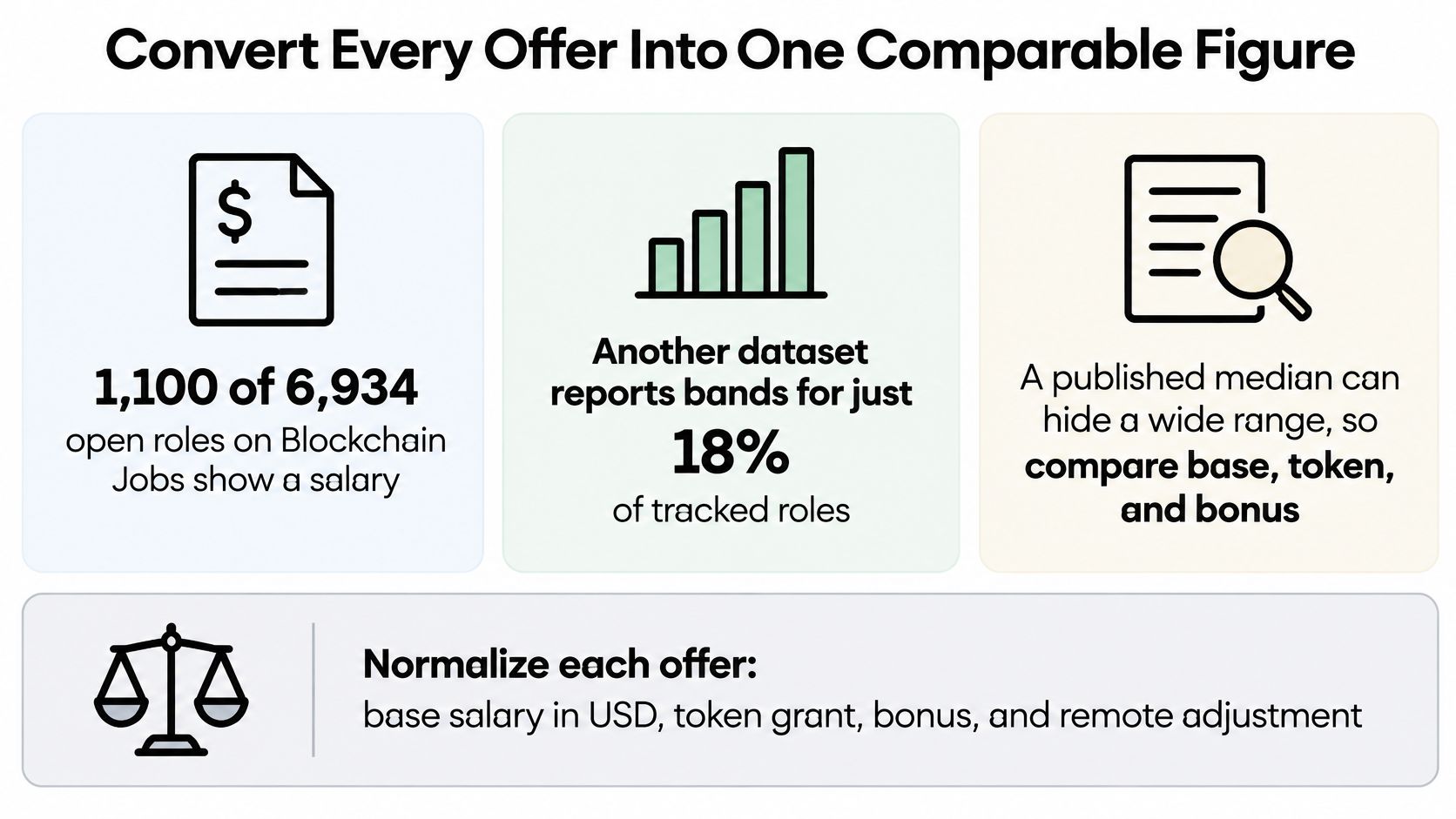
Only 1,100 of our 6,934 open roles across crypto, DeFi and Web3 show a salary. Separately, ChainJobs' crypto salary coverage reports salary bands for just 18% of tracked roles, illustrating why a published median near $195,000 shouldn't be interpreted as the expected pay of a typical crypto worker.
Disclosure bias starts before anyone calculates a median. Employers that disclose compensation may differ from those that don't, and advertised ranges may omit ownership, bonuses and benefits. A precise-looking result can still describe a selective slice of hiring.
Separate payment currency from investment exposure
The Pantera-linked compensation figures reported by Crowdfund Insider distinguish crypto compensation participation, at 9.6% of respondents, from token-grant values, where the average was $341,157 but the median was $87,500. The same report puts USDC at 63% and USDT at 28.6% of crypto-denominated salary payments.
These are different measurements. The average token grant isn't the average salary of employees receiving crypto, and a stablecoin paycheck isn't the same instrument as a speculative token allocation.
Pay components to verify before comparing offers
| Pay component | What to verify | Why it changes the number |
|---|---|---|
| Base salary in fiat | Annual amount and currency | Guaranteed cash; 97% of surveyed base pay was fiat in the earlier Pantera survey |
| Stablecoin base pay | Which stablecoin, payment schedule and conversion costs | USDC and USDT accounted for over 90% of crypto-denominated salary payments |
| Token grant | Token quantity, current value, vesting schedule, cliff and sale restrictions | Volatile; reported average grant was $341,157 against a median of $87,500 |
| Equity | Share count, strike price, fully diluted ownership and vesting | Published salary ranges commonly omit ownership value |
| Bonus and benefits | Target percentage, eligibility, relocation and tax support | Advertised ranges may exclude these components |
Build an annual comparison
Consider a hypothetical $150,000 salary plus tokens against a $190,000 all-cash offer. The token-bearing offer must provide enough accessible, risk-adjusted annual value to close the cash gap before it becomes financially equivalent.
Start with the comparison period. Count only compensation attributable to that period, rather than adding an entire multiyear grant to an annual salary.
For liquid tokens, use a documented current market price, then account for sale restrictions, trading costs and available liquidity. For vesting tokens, count the portion scheduled to become accessible during the period and apply a conservative discount for uncertainty. If the cliff falls outside your comparison period, don't count those tokens as spendable compensation during it.
For equity, ask for the fully diluted ownership percentage and exercise cost. A share count without a denominator isn't a useful valuation. If there's no credible liquidity route, keep equity in an upside scenario rather than treating it as guaranteed salary.
A practical comparison formula is:
Comparable annual value = guaranteed annual pay + conservative realizable variable compensation + personally useful benefits − unavoidable employment and conversion costs.
Keep the guaranteed subtotal visible alongside the combined figure. That prevents an aggressive token assumption from making a fragile offer appear equivalent to dependable cash.
Send the same checklist to every recruiter
- Payment terms: Confirm base currency, payment method, exchange-rate convention and who pays transaction fees.
- Ownership documents: Request token quantity, vesting, cliff, termination treatment and equity dilution information.
- Variable pay: Establish the bonus target, conditions and whether the amount is discretionary.
- Location terms: Confirm the applicable pay zone and employee or contractor status.
- Tax treatment: Have a jurisdiction-qualified adviser review receipt, vesting, exercise and disposal consequences.
For less conventional arrangements, the decentralized jobs guide helps frame the employment questions that need answers before you price the package.
Shortlist three pay-disclosing roles, send each recruiter the same checklist, and compare the resulting annual figures using identical assumptions. Set daily job-email alerts so you can track fresh bands rather than negotiate from a single listing.
How Experience Moves You Up the Pay Ladder
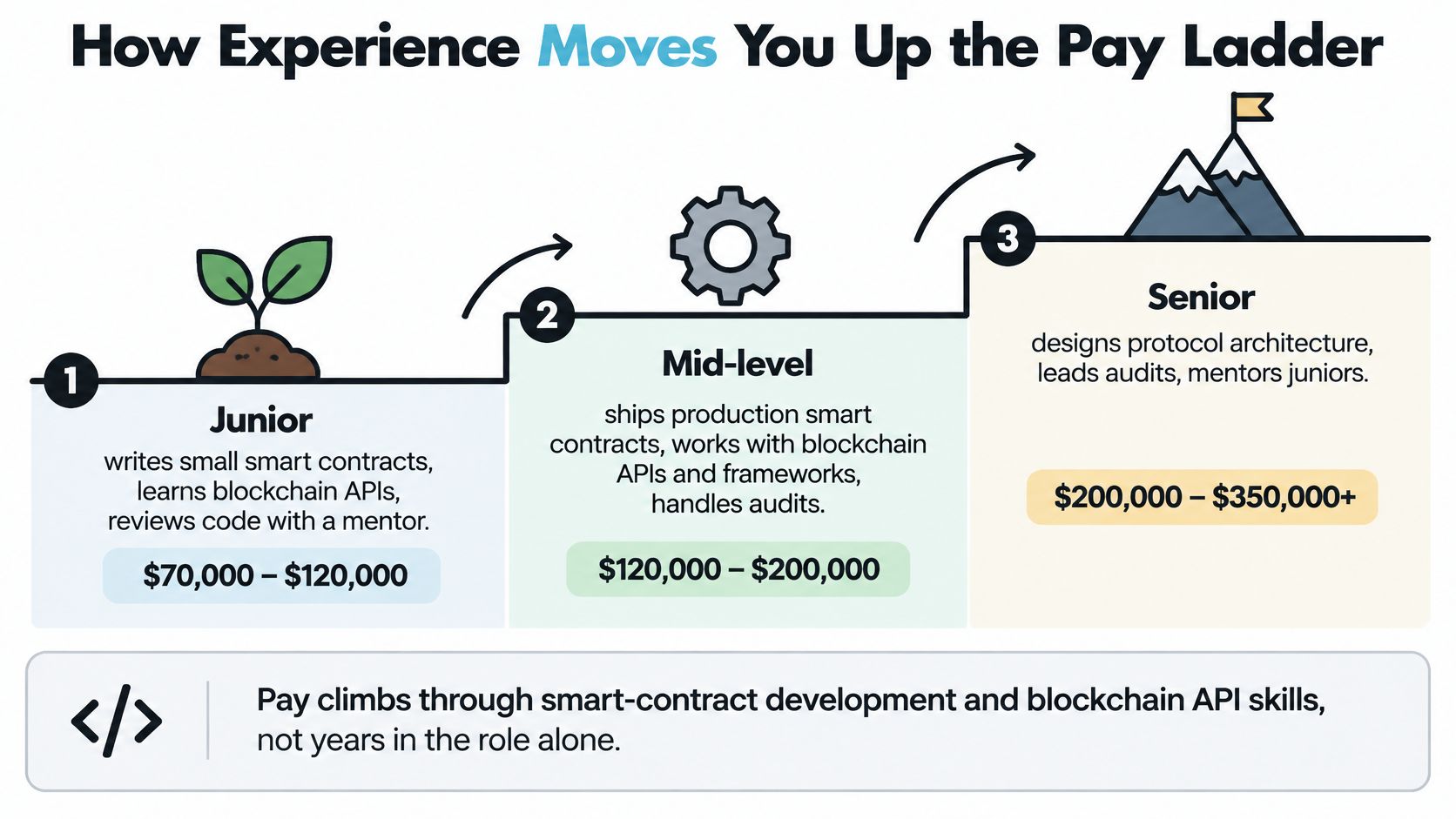
Experience supports higher compensation when it demonstrates wider ownership. Smart-contract development, blockchain APIs, Hardhat or Foundry, and security auditing form a useful progression because they let candidates show implementation skill alongside operational judgment.
The career targets below use the junior, mid-level and senior developer bands as reference categories, not promises. A project becomes persuasive hiring evidence when you can explain what you built, what you tested and which decisions were yours.
Build evidence in stages
Build and test on a testnet. Target junior roles by producing a small, readable repository with deployment scripts and automated tests. Put the contract's purpose, test strategy and your contribution on your CV, rather than listing Solidity as an unsupported skill.
Ship a carefully scoped mainnet contract. This can strengthen a junior application or support a move toward mid-level responsibility when you own the feature end to end. Include a traceable contract address, deployment notes and an explanation of permissions. Don't deploy unnecessary financial risk merely to obtain a mainnet credential.
Contribute to an audit, bug bounty or security review. Aim to strengthen your case for mid-level work through a reproducible finding, regression test or documented remediation. Explain the vulnerable assumption and the fix; distinguish your contribution from the team's final report.
Own a protocol component. Senior applications need evidence of architectural responsibility, such as a rollup module or security-critical contract. Your CV should state the component's boundaries, dependencies, threat model and the decisions you approved.
Make the CV prove the scope
A repository link alone asks the interviewer to reconstruct your contribution. Add a concise project note that identifies your role, collaborators, constraints and the artifact that verifies the work.
For community, product and legal candidates, use the same evidence standard without copying an engineering portfolio. Document launches, user-growth initiatives or compliance decisions with dates and scope, and distinguish team results from your personal responsibility.
Choose the next stage to reach within 12 months as a development goal, not a compensation forecast. Build the missing evidence before changing the seniority label on your CV.
How Hiring Teams Test Candidates for Crypto Roles
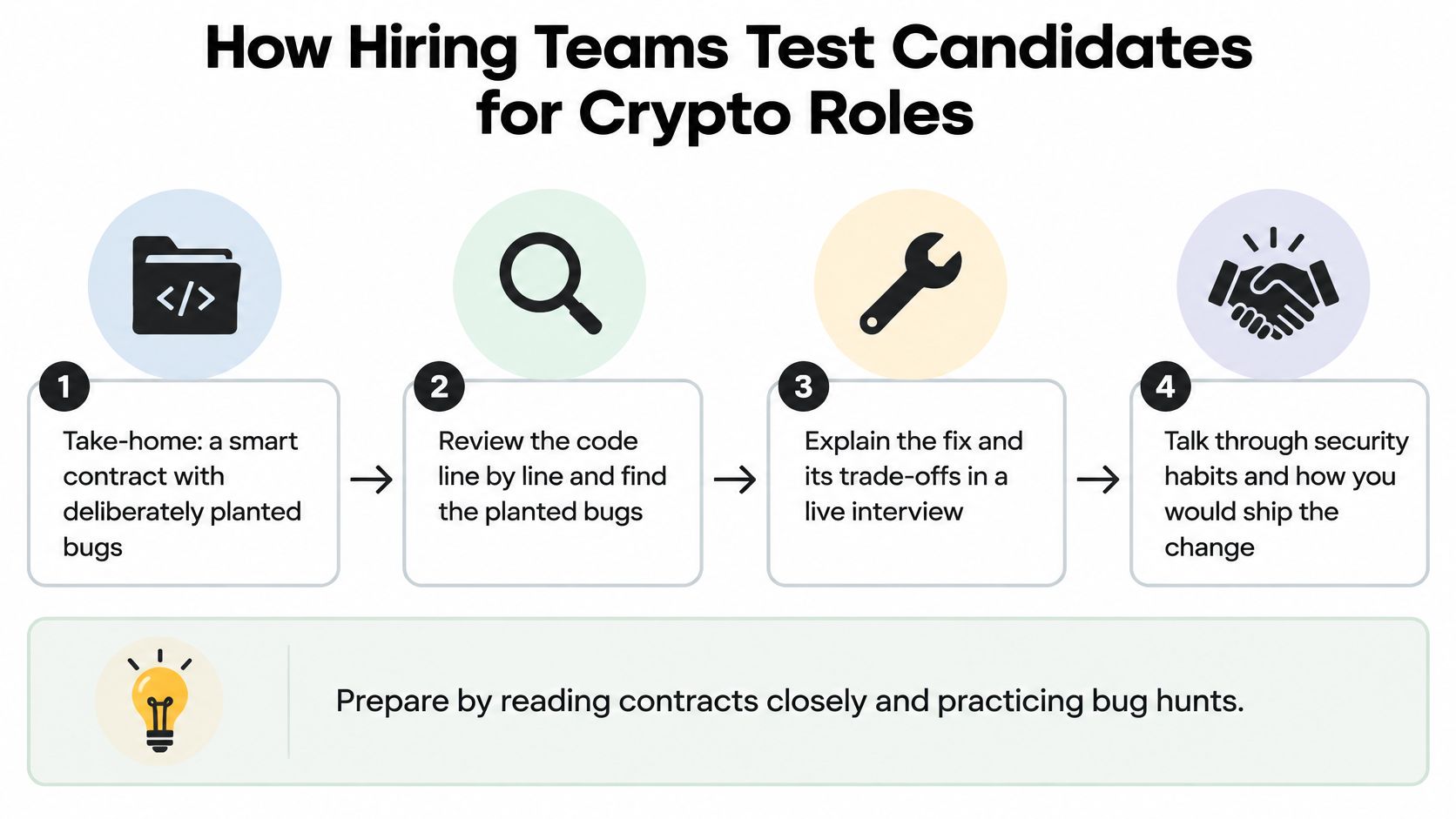
A useful crypto interview tests security judgment directly. The Pin blockchain-talent recruiting guide recommends giving candidates a smart contract containing deliberately planted vulnerabilities and verifying mainnet deployments through relevant addresses; it also cites compensation starting at $150,000 for mid-level blockchain positions.
That benchmark is a reference point, not a universal minimum. The candidate still needs to establish that their production responsibility matches the employer's definition of mid-level work.
Prepare around what the interviewer can verify
A technical screen may focus on smart-contract coding, followed by a separate security deep dive. Prepare to explain both whether the code works and how an attacker could make it behave unexpectedly.
Assemble your deployment inventory. List the network, contract address, repository and purpose of each relevant deployment. This gives the interviewer a direct route from your CV claim to an inspectable artifact.
Review your actual contribution. Be ready to explain proxy relationships, permissions and the code version deployed at each address. Interviewers need to separate personal ownership from participation in a large team.
Practice vulnerability detection. Review access-control gaps, reentrancy and unchecked external calls. Describe the exploit preconditions before proposing a fix, then explain which regression test would demonstrate that the fix works.
Prepare a two-minute design explanation. Choose a real trade-off involving upgradeability, gas cost or trust assumptions. The interviewer is checking whether you can defend a decision without pretending it had no disadvantages.
Ask about compensation composition. Request the cash, token and equity split for the actual level being considered. This helps establish whether the employer's assessment of your responsibility aligns with its proposed package.
Rehearse reasoning, not memorized answers
For the general coding portion, pattern-focused coding practice on PracHub can complement contract-specific bug hunts. Use it to rehearse explaining an approach and checking edge cases, not as a replacement for reading Solidity and understanding transaction behavior.
When discussing a vulnerability, distinguish the immediate patch from the process change that would prevent a recurrence. That might mean an invariant test, a permission review or a deployment check.
If you don't have mainnet work, present reviewed or audited testnet projects and open-source contributions instead. Be explicit about their limits, and make your reasoning easy to inspect.
Blockchain Jobs brings together crypto, DeFi and Web3 opportunities, including remote roles and listings with disclosed salary ranges. Visit Blockchain Jobs to shortlist roles that match your scope, compare their compensation terms and sign up for new job emails once a day.