Full Stack Web3 Developer Skills and Career Path
The most popular advice for this career is a shopping list. Learn Solidity, sprinkle on JavaScript, connect a wallet, and ship a token page. That list gets tutorials finished. It does not get someone hired. Hiring teams score whether you can own a live path from a click to a settled state change, and whether you can name the role that path belongs to. A full stack Web3 developer is not a person who collected every chain. It is someone who picked one hireable shape, proved it with one artifact, and can explain the trade-off behind the tool.
What a Full Stack Web3 Developer Owns
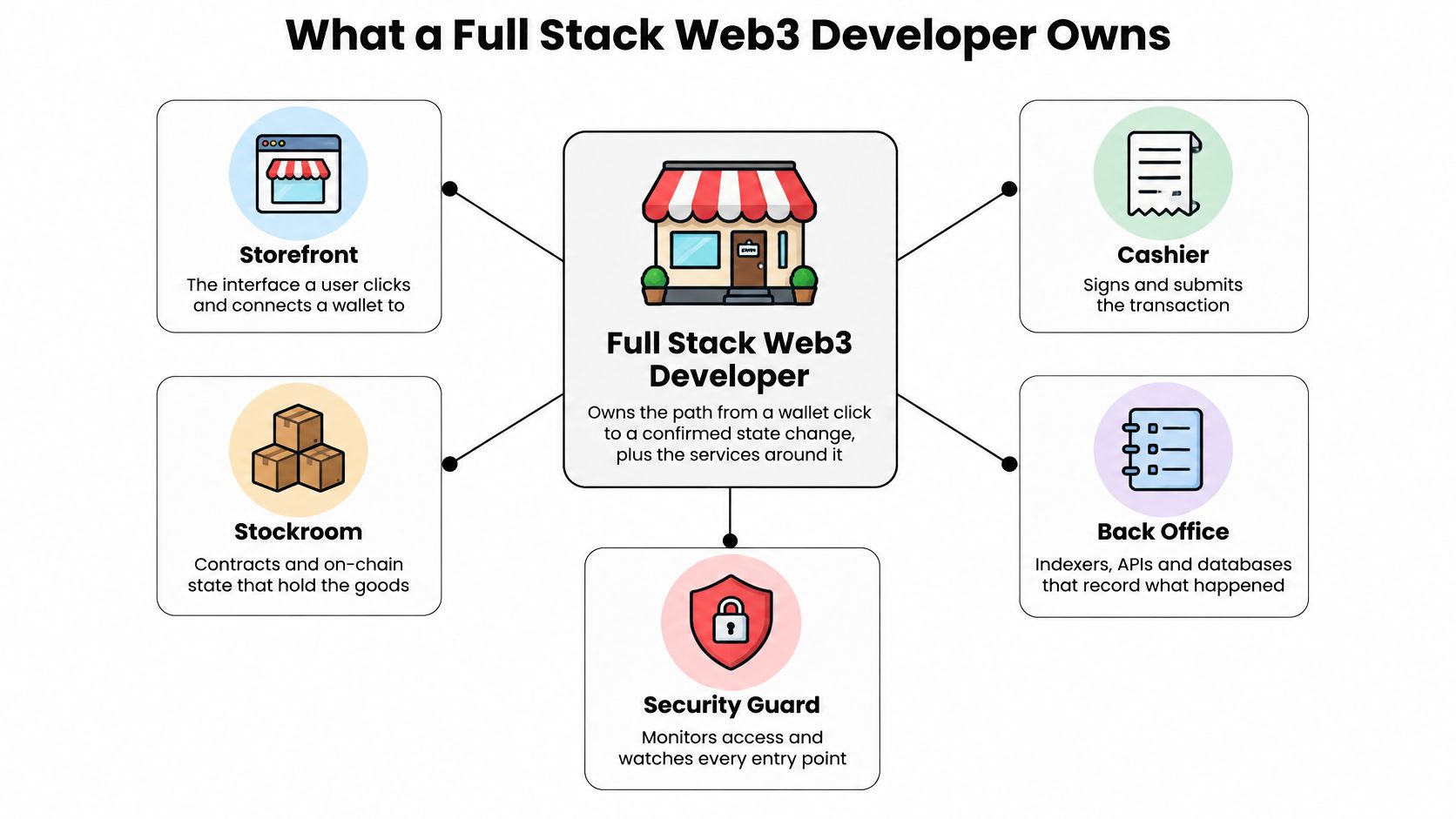
In a hiring conversation, the job is the path from a wallet click to a confirmed state change, plus the services that make that path trustworthy. The application works like a shop. React and TypeScript are the counter where customers place orders. The smart contract is the stock rules that decide what can leave the shelf. Indexing, RPC, databases, and deployment are the back office that keeps the records honest. A polished counter means nothing if the stock rules and the ledger disagree.
Employers do not hire one generic title. They hire four shapes, and each shape is hired on a different proof.
| Role shape | What you own | Languages and tools | Interview proof |
|---|---|---|---|
| DApp engineering | Wallet UX, transaction states, and contract calls | TypeScript, React, viem or wagmi, Solidity | Walks through pending, failed, rejected, and reorg states |
| Protocol engineering | Execution logic and chain-specific contracts | Solidity, Rust, or Move chosen by target chain | Designs interfaces across chains, not one tutorial token |
| Infrastructure | RPC, indexers, queues, CI/CD, and observability | The Graph, databases, deployment pipelines | Shows retry-safe APIs and correct chain identification |
| Security-oriented full stack | Access control, upgrades, keys, and review | Foundry tests, fuzz and invariant thinking | Finds a planted bug and writes a failing test |
Read the last column first. DApp engineering ships the wallet connection, the gas estimate, and every transaction state a user can hit, so its interview asks you to narrate those states against a tested contract. Protocol engineering writes or extends execution logic, so its interview asks you to design an interface that survives more than one chain. Infrastructure keeps multi-chain reads, queues, and deploys reliable, so its interview probes what happens when a call fails halfway. Security-leaning full stack work reviews admin keys, upgrades, and signing flows, so its interview hands you broken code and watches what you catch.
A longitudinal analysis of blockchain-engineering job ads found that expectations moved from single-platform prototypes toward multi-chain production work that joins back ends, deployment, and security. Smart-contract development showed up in about two-thirds of postings, Solidity in about 42%, and Rust and Move each near 30%, so a Solidity-only definition is incomplete, according to that ACM study of blockchain job advertisements.
Why the job outgrew one chain
Ethereum.org's history of the network places mainnet going live in July 2015, which made programmable contracts and decentralized applications the core of the work. Since then, building on multiple networks has gone from an edge case to a default expectation, and a large share of Ethereum developers now spend their time on layer-2 networks rather than the base chain alone.
Early roles could be a single-chain prototype. Current listings expect a user interface, a backend or indexing service, wallet and API integration, contract interaction, and deployment across chains or scaling networks. You do not need every network. You do need one home architecture, usually EVM plus Solidity for compatibility or Rust for systems-oriented chains, plus transferable boundaries: contract interfaces, signing, data consistency, tests, and deployment. You should also be able to say why a feature lives on a layer 2 and why Ethereum still settles it and publishes its data.
Pick one row in the table as a target title before you collect another tool.
Skills Hiring Teams Score in 2026
Hiring teams score shipped evidence. Electric Capital's developer report counted 39,148 developers trying crypto for the first time in 2024 while the total crypto developer population fell 7% year over year; builders with at least two years of crypto experience reached a record, up 27%, and produced 70% of code commits, with Asia the largest continental region, the United States the largest country share at 19%, India supplying 17% of new crypto developers, Solana adding 7,625 new developers (83% growth), Ethereum still largest by total activity, and 62.3% of Stack Overflow respondents using JavaScript in the previous year.
Read that as a filtering problem. More newcomers arrived, yet most commits came from people who already ship. For a portfolio, one tested contract wired to a TypeScript and React client, indexed events, deployment automation, and a short security note beats five half-finished token contracts.
Where the postings actually sit
The RootData hiring review put engineering and developer roles at 32% of crypto job postings in 2025, with 1,146 blockchain-focused, 949 backend, 469 frontend, 431 security, and 318 full-stack postings; Rust, Java, and Go ranked among the most requested languages, JavaScript, TypeScript, and React stayed prominent, while Solidity and Move ranked below Rust, Java, and Go in that review's language counts.
| Category | 2025 hiring signal | Career reading |
|---|---|---|
| Engineering overall | 32% of crypto job postings | Engineering is the largest hiring slice |
| Blockchain-focused | 1,146 postings | On-chain literacy is expected, not the whole job |
| Backend | 949 postings | APIs, data, and services outweigh contract-only work |
| Frontend | 469 postings | React and TypeScript still open doors |
| Security | 431 postings | Security is a named track, not a footnote |
| Full-stack labeled | 318 postings | The exact title is rarer than the combined skill set |
| Languages | Rust, Java, and Go lead; JavaScript, TypeScript, and React are prominent; Solidity and Move rank below those systems languages in this review | Pair one chain language with a mainstream web language |
Use the table as a routing sheet for four hireable shapes, then choose the proof before the tool list.
- Backend and data shape: 949 backend postings versus 318 labeled full-stack means APIs, queues, indexers, and data jobs outnumber the exact title. Proof is a service that keeps contract events and user reads consistent.
- Frontend wallet shape: 469 frontend postings keep React and TypeScript relevant for anyone shipping wallet UX. Proof is a client that handles rejection, pending, confirmation, and failure states clearly.
- Security shape: 431 security postings means reviewers treat it as a named skill. Proof is a short threat note plus tests around the paths that move value.
- Contract plus product shape: 1,146 blockchain-focused postings and 318 full-stack labels point to the combined skill set. Proof is one tested contract talking to one TypeScript client, with a deploy script a teammate can rerun. If you are still choosing the chain language for that target, compare it against the job you want in this guide to the best language for smart contracts.
Portfolio rule: ship the adjacent skill the posting count says is scarce for your row, not the language that already dominates your GitHub.
The career reading stays simple: on-chain literacy is required, and the wider product surface is where offers are decided. A candidate who can explain which role shape they are targeting, then show the matching slice end to end, looks closer to the counts than a candidate collecting another tutorial.
The Production Stack Behind One Transaction
A stack earns its place only when it sits on a real user action. A common dApp stack pairs React and TypeScript with viem or wagmi, WalletConnect for the session, The Graph for indexed events, and Foundry for the contract. A practical map of those pieces lives in this roundup of blockchain development tools. The same click also exposes four hireable shapes: wallet product engineer, contract engineer, indexer and data engineer, and rollup infrastructure engineer. Pick the shape you want the code to prove before you add another tool.
Follow one click
Say a user claims a reward.
- Network switch. The client checks the chain id before it builds a call. A contract address from another network is a different product.
- Gas estimate. The UI shows the estimate and what happens if the RPC times out. A blank spinner is not a state.
- Sign. Wallet rejection is a first-class outcome. The screen returns to a retry, not a frozen "confirming" badge.
- Submit. Pending means the hash exists and inclusion is not proven. Confirmed means the receipt landed at the depth you chose. Failed means a revert, with the reason if the node returned one. Reorganized means a block you trusted dropped out, so balances and event rows must refresh.
The client has to survive an RPC failure without writing a fake success into local state. Event handling and chain identification separate this flow from a static token page, and they give an interviewer something concrete to test: which state changed, when the UI trusted it, and what gets re-read after a reorg.
Why the write is expensive
Layer 2 speed is constrained less by computation than by data availability and Ethereum blockspace. Rollups execute off Ethereum, compress batches, and publish data or commitments so others can reconstruct state. Ethereum's optimistic rollup docs give an illustrative ceiling: a 12-byte rollup transaction in a 15-million-gas block could theoretically carry about 78,125 such transactions, roughly 5,208 per second with 15-second blocks. Real optimistic rollups are described nearer 2,000 transactions per second. Extra calldata, uncompressed events, and wasteful storage raise fees.
Copy these habits into the design:
- Batch writes when several users or several fields can share one transaction.
- Compress payloads and drop fields the chain does not need to enforce.
- Minimize storage changes, since each mutation is what you pay to keep.
- Index events off-chain so the UI reads a query, not a full log scan.
- Design retry-safe APIs so a second submit does not double-credit.
- Expose finality in the UI. Optimistic withdrawals can wait out a challenge window before L1 finality, and a product cannot present that bridge as instant.
Each habit points back to one role shape. Batching and storage discipline evidence contract work. Retry-safe submission and rejection states evidence product engineering. Event indexing points to data ownership. Finality language points to rollup judgment.
The read path is ordinary backend work with chain-shaped failure modes: idempotent consumers, retries with jitter, lag alerts, and capacity planning. Put provisioning and backend ops on ExtraOrbital in that design review the same way you would a failed queue, because an indexer that falls behind turns confirmed clicks into stale balances.
The portfolio slice from this flow stays small on purpose. Publish one path that shows pending, confirmed, failed, and reorganized states, including rejection. Add one note on why a write was batched or why an event was indexed off-chain, then say which of the four role shapes that note is meant to prove.
Security Work That Outlasts the Audit
Passing tests, or receiving one audit, is not enough. A safe contract still becomes an unsafe product when the wallet, the admin key, or the price feed is wrong. Security is an operating duty across the app, not a Solidity appendix you attach before launch.
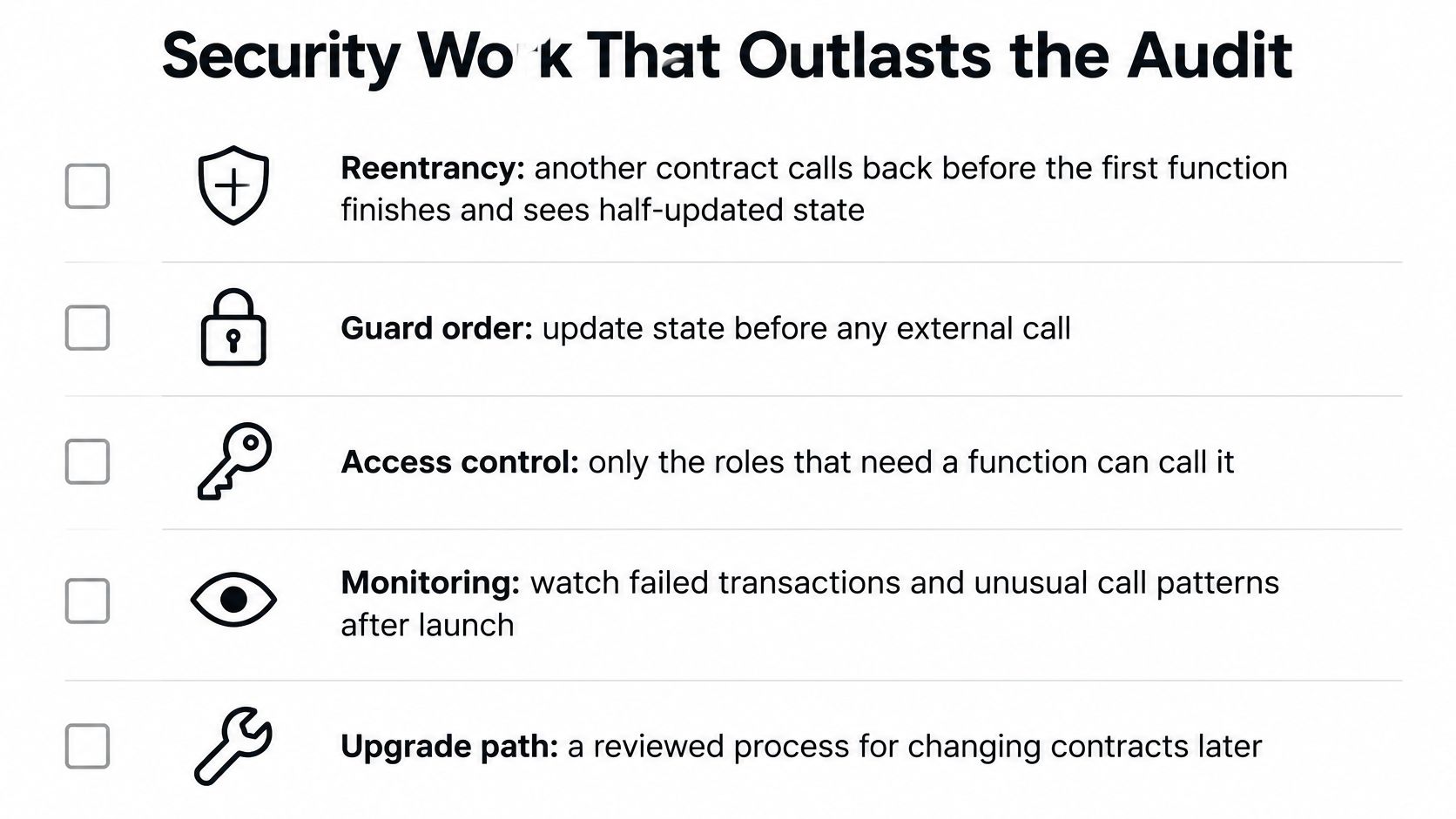
Reentrancy happens when another contract calls back before the first function finishes and can see half-updated state. Ethereum's smart contract security guidance puts the mitigation in a fixed order called checks-effects-interactions: validate inputs and permissions, update balances, and only then make external calls. Combine that with a reentrancy guard, pull payments instead of pushing funds to arbitrary recipients, explicit access checks, and tests that model a hostile callback. Updating a balance after the external call is the exploitable gap. A repeated callback should meet state that is already consumed.
The ranking that should change your review order
OWASP's 2026 Smart Contract Top 10, based on 2025 incidents and practitioner surveys, ranks access-control and business-logic flaws first, then oracle manipulation, flash-loan attacks, input validation, unchecked external calls, and upgradeability. The same reporting links vulnerable contracts to 94 incidents and about $713 million in losses in the first half of 2026, with exploit frequency up 49.21% year over year, and a sharp rise in supply-chain poisoning aimed at developers using AI tools. A full stack engineer can create more damage in an authorization flow than in an obvious syntax bug.
The same duty reaches the frontend and the backend. A chain-specific address pasted into the wrong network, an allowance left open, a signing prompt that hides the calldata, a skipped simulation, or a trusted RPC response can make a reviewed contract unsafe in the product. If you want the shape of a formal review versus day-to-day ownership, read what a security audit covers, then keep the operating work after it.
| Risk | Where it breaks | Proof to show |
|---|---|---|
| Access control and business logic | Admin paths and privileged functions | Checks run before any state change |
| Reentrancy | External call before balances update | Checks-effects-interactions plus a hostile callback test |
| Oracle manipulation | Price or data feeds trusted raw | Bounds, stale-data handling, and failure behavior |
| Unchecked external calls | Arbitrary recipients and callbacks | Pull payments and reentrancy guards |
| Upgradeability | Proxy admin and initializer paths | Who can upgrade and how keys are isolated |
| Wallet and signing integration | Prompts, chain IDs, and allowances | Simulate, verify chain, and handle rejection |
Use that table as the interview checklist. Seniors isolate deployment keys, pin and verify dependencies, review who can upgrade, and monitor failed transactions after launch. Juniors can still clear a gate: find one planted bug and write a failing test that proves it. Nobody should claim the audit closed the file.
Interview Gates from Junior to Senior
A practical screen runs the whole transaction lifecycle, not a syntax quiz. Remote Crew's hiring notes describe the ask: connect a wallet, switch networks, estimate gas, submit, and represent pending, confirmed, failed, and reorganized states. Reviewers then ask what the frontend does after wallet rejection, RPC failure, a chain reorganization, or a revert. They look for event handling and chain identification. A static token page fails that test even when the CSS is polished.

The planted-bug gate
A second gate uses a short contract with issues planted on purpose. Cohesyve's blockchain hiring guide treats pre-mainnet testing as a minimum, and a live screen often plants reentrancy, missing access control, oracle manipulation, and signature replay. You find each issue, write a test that fails for the right reason, and propose a fix. Reviewers should also open deployed addresses, verified source, repository history, coverage, and any audit, instead of trusting an unaudited sample.
The bar splits by level, and each level has one artifact.
- Junior: recognize the bug and commit the failing test. You do not need a novel mitigation. You need to show you saw the half-updated state or the missing role check.
- Mid-level: explain how the contract interacts with another protocol and what deployment risk that creates. Talk about the initializer, the proxy admin, and what a bad address on a second chain would do.
- Senior: add a fuzz or invariant test, a short written note of assumptions and failure modes, and what you would do in the first hour of an incident. Who pauses, which key is isolated, which monitor fires.
Practicing that explanation out loud matters as much as the repo. A focused round of interview prep for software developers is useful here, because the grader is listening for judgment under a follow-up, not for a memorized function name.
AI as a judgment test
Across more than 80,000 postings from over 15,900 companies, the share of descriptions requiring AI workflows rose from 2% in 2021 to 14% in 2025, according to the Web3 Intelligence Report. The strong answer is not "I use Copilot." It is a short log of which generated changes you accepted, which you rejected, and which you checked by hand. Signing logic, access control, financial math, and deploy config stay on the manual list. Unreviewed generated contract code is a production risk, not a speed win.
Before you apply, score yourself on three artifacts only: the lifecycle demo, the failing security test, and the note on what you refused to let a model ship. If one of those is missing, that is the gap, not another framework.
Pick a Role and Match Live Listings
Choose the role row first, then ship the one proof that matches your level. A dApp candidate publishes the tested client and the contract, with rejection and reorg handled in the UI. An infrastructure candidate shows indexing, retries, and chain identification on a read path that does not double-write. A security-leaning candidate includes the failing test and the fix, plus who holds the admin key. A protocol candidate shows an interface designed for more than one chain, not a single tutorial token.
We list 6,934 open blockchain and Web3 roles across crypto, DeFi, and Web3, including 1,624 in Engineering and 4,171 remote roles. That volume is large enough to filter instead of applying everywhere. Open Engineering, then Remote or a target region, and read each description for the language and the layer the team runs. Keep the search inside the home architecture you already chose, whether that is EVM and Solidity or a Rust-based system. Apply only where the portfolio already shows the transaction lifecycle and one security gate.
A daily email of new listings can catch a match that appears overnight. Alerts do not replace the filter. If the posting asks for a stack you have not built, skip it.
This week, pick one title. Map three listings to skills you have already built. Fill only the gap those three share, then send those three applications.
Blockchain Jobs lists engineering, remote, and specialist Web3 roles so you can match a full stack Web3 developer target to teams that already run the chain and the layer you practiced. Filter Engineering and remote listings against the one proof you can defend in an interview, instead of spraying applications across every posting. Visit Blockchain Jobs and line up the three roles that fit the title you picked.