
Web3 Application Development: A Career Guide for 2026

You’re probably seeing the same pattern many good developers see right now. Web3 job listings ask for Solidity, wallets, rollups, indexing, security reviews, and production deployment discipline. The roles look interesting, often more specialized than standard frontend or backend work, but the path into them feels messy.
That confusion is normal. Web3 application development isn’t just “learn Solidity” or “build a token.” It’s a stack of decisions about architecture, testing, UX, infrastructure, and security. The developers who break in fastest usually stop treating Web3 as a trend and start treating it like a systems discipline with clear hiring signals.
The opportunity is real. The Web3 development service market reached $4.43 billion in 2024 and was estimated at $6.15 billion in 2025, a year-over-year increase of about 38.8%, according to this Web3 market overview. That growth matters for your career because companies don’t just need “blockchain people.” They need engineers who can ship usable products, product managers who understand protocol constraints, and designers who can remove wallet friction.
If you’re still figuring out where to start, a practical overview of the Web3 developer path helps frame the job market. The useful question isn’t whether Web3 is hiring. It’s which part of Web3 application development you want to become excellent at.
Your Starting Point in Web3 Development
A mid-level Web2 developer usually enters Web3 with one wrong assumption. They think they need to understand everything before building anything. That slows them down.
In practice, hiring managers rarely expect broad mastery on day one. They want evidence that you understand the new trust model. In Web2, your server owns state and enforces rules. In Web3, a blockchain and its smart contracts enforce critical rules, and your app becomes a careful interface to those rules.
What usually confuses developers first
The initial struggle isn't typically with syntax. It's with boundaries.
A typical dApp forces you to answer questions many Web2 apps hide:
- What belongs on-chain: token balances, permission logic, settlement rules, immutable records
- What stays off-chain: large media, search-heavy content, session-like app state, fast-changing UI data
- What users control directly: wallets, signatures, assets, approval flows
That means the specialization path becomes clearer once you choose your center of gravity.
| Background | Strong entry point in Web3 |
|---|---|
| React or frontend | dApp frontend, wallet UX, transaction states |
| Backend or platform | indexing, node integrations, API layers, infrastructure |
| Security | contract review, test design, secure deployment workflows |
| Product | protocol tooling, onboarding, compliance-heavy UX |
The fastest way into Web3 is usually adjacent entry, not total reinvention.
What employers read between the lines
When a candidate says they’re “passionate about blockchain,” that doesn’t tell a hiring manager much. When they say they built a small app that signs wallet messages, reads contract state, handles failed transactions cleanly, and documents trade-offs, that gets attention.
That’s because Web3 teams hire for operational judgment. They want someone who knows where things break, not just someone who knows the names of the tools.
The Architecture of a Decentralized Application
A decentralized application looks familiar at the surface. There’s still a frontend, data, business logic, and user actions. The difference is where trust lives.
In a normal Web2 app, you ask a server to process requests and store data. In a dApp, the critical logic often lives in smart contracts, and users interact through wallets that sign actions. That shift changes performance, security, and product design all at once.
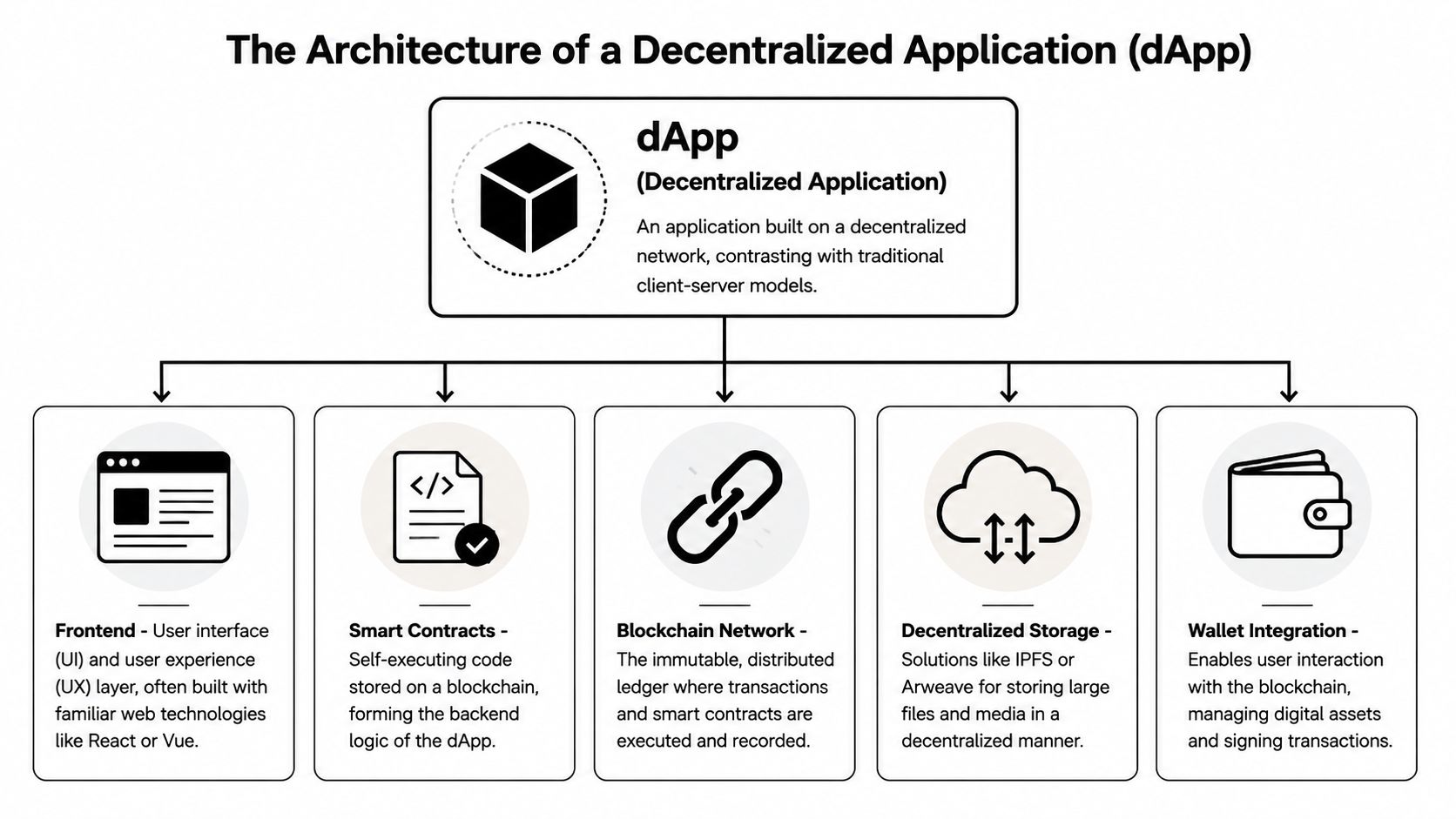
The five parts that matter
Think of a dApp as five connected layers.
Frontend The UI is often still React, Next.js, or Vue. The difference is that the frontend doesn’t just call your backend. It also reads chain state, asks wallets for signatures, and handles transaction lifecycles.
Wallet integration Wallets are the user’s identity, signer, and asset manager. That means login, authorization, and payment behavior often converge into one flow.
Smart contracts These hold the app’s enforceable rules. Once deployed, they become difficult to change safely. That’s why smart contract design punishes weak planning more than most backend systems do.
Blockchain network This is the execution and settlement layer. It gives you shared state and verifiable actions, but it also imposes latency, fee constraints, and public visibility.
Decentralized storage and indexing Not everything should go on-chain. Large files and rich content need a different home.
Why IPFS and The Graph matter
Web3 applications use decentralized storage like IPFS and query protocols like The Graph, which improve data availability and censorship resistance compared with centralized server models, as described in this Web3 developer roadmap.
That sounds abstract until you build something real. If your app stores media, metadata, or user-generated content, pushing everything into contract storage is usually the wrong move. It becomes expensive and rigid. IPFS gives you a decentralized way to store content. The Graph helps your app query blockchain-derived data without making your frontend do all the heavy lifting directly against nodes.
A lot of bad dApps aren’t bad because the contract is broken. They’re bad because the data model ignores how users actually search, load, and verify information.
The trade-off developers need to respect
Decentralized architecture improves resilience and user control, but it doesn’t remove complexity. It moves complexity.
You’ll often trade speed and simplicity for auditability and portability. A product feature like subscriptions, recurring billing, or usage-based charging becomes more interesting in this environment, especially when teams explore crypto and stablecoin payments as part of product design. That’s not just a payment decision. It changes how contracts, wallets, and application state fit together.
Hiring managers notice developers who understand this. They don’t want someone who treats decentralization like decoration. They want someone who can explain why a feature belongs on-chain, off-chain, or in a hybrid model.
Your Essential Web3 Tech Stack and Tools
If architecture is the theory, the toolchain is where your credibility gets tested. Interviewers don’t care whether you’ve memorized every library. They care whether you picked tools that match the chain, deployment model, and testing requirements.

Contract development tools
The first hard decision is chain family. That determines language, framework shape, and testing workflow.
Hardhat and Truffle are core environments for testing, debugging, and deploying smart contracts. Solidity is the key language for EVM chains, while Rust is central for Solana, and that choice shapes the whole workflow, as outlined in this guide to building Web3 applications.
For EVM work, I’d tell most developers to get comfortable with this baseline:
- Solidity: You need to write readable contracts, not just compiling ones. Focus on storage layout, access control, events, upgrade considerations, and external call risks.
- Hardhat: Useful for local development, deployment scripting, plugin support, and debugging.
- Truffle: Still appears in legacy codebases and some job descriptions, so it’s worth recognizing even if it’s not your daily choice.
- Remix IDE: Good for fast prototyping, contract experiments, and isolating small behaviors.
What employers often test here isn’t syntax. It’s whether you can reason about state transitions and failure conditions.
Frontend and contract interaction
The second layer is the app that people touch. Many otherwise strong candidates underperform at this layer because they build blockchain interactions as if they were normal API calls.
A competent dApp frontend developer knows how to handle:
- Wallet connection states
- Network mismatches
- Pending, confirmed, and failed transactions
- Readable contract errors
- Optimistic UI only where it’s safe
If you want more depth on the contract side before tackling the UI edge cases, this breakdown of smart contract development skills is useful because it aligns closely with what hiring teams screen for.
Infrastructure and node access
Every serious dApp needs reliable access to chain data and transaction broadcasting. You may use managed RPC providers, self-hosted infrastructure, or a mixed approach depending on reliability, compliance, and cost needs.
A hiring manager doesn’t need you to list vendors from memory. They want to hear how you’d think through these choices:
| Need | What a strong candidate considers |
|---|---|
| Read performance | Caching, indexing, and RPC request patterns |
| Write reliability | Retry logic, nonce handling, transaction replacement |
| Multi-chain support | Network abstraction, environment separation, chain-specific quirks |
| Observability | Logs, failed transaction tracking, wallet error capture |
Later in the process, interviewers often ask you to explain your build loop, a point at which many candidates become vague.
The stack hiring managers actually value
The most valuable stack isn’t the flashiest one. It’s the one that proves you can ship safely.
A solid mid-level Web3 profile usually shows three things:
- Depth in one chain ecosystem
- Reliable testing habits
- Enough frontend or backend skill to integrate contracts into a real product
Don’t present yourself as a “full-stack blockchain engineer” if you can’t explain your local testing setup, deployment scripts, and wallet failure handling in detail.
That answer alone separates résumé familiarity from real capability.
Best Practices That Get You Hired
Teams don’t pay more for tool awareness. They pay more for risk reduction. In Web3, one mistake in production can lock funds, break permissions, or destroy trust fast. That’s why best practices aren’t polish. They’re part of the job.

Security first, not security later
A lot of candidates say security matters. Fewer can explain how they build around it from the start.
That means reviewing external calls carefully, isolating privileged actions, avoiding unnecessary complexity in upgrades, and thinking through how contracts interact under stress. It also means understanding where static analysis helps and where runtime testing catches different classes of problems. If you want a quick refresher on that distinction, this comparison of SAST and DAST is a useful framing tool for security discussions.
In interviews, talk about security as an engineering habit. Not as an audit event.
Testing that mirrors production risk
Web3 testing has to go beyond “unit tests passed.” Production failures often come from integration assumptions, environment mismatches, and bad handling of edge conditions.
A stronger testing story includes:
- Unit tests: Contract logic in isolation
- Integration tests: Contract-to-contract and frontend-to-contract behavior
- Fork-based tests: Realistic interactions against current network state
- Performance checks: Especially where loops, storage, or repeated external calls can get expensive
Practical rule: if your tests don’t cover failure paths, they’re mostly proving the happy path can compile.
UX is a hiring differentiator
Many developers still treat UX as a design team concern. That’s a mistake in Web3.
UX is a primary barrier to broader Web3 adoption, and intuitive interfaces for decentralized credentials and compliance-heavy roles remain an underserved but important skill, according to this analysis of Web3 UX friction. If you can design flows that make signatures understandable, approvals explicit, and recovery paths clear, you become more valuable than another candidate with the same contract knowledge.
A few habits matter a lot:
- Explain transaction intent: Users should know what they’re approving.
- Surface chain context: Wrong network states should be obvious.
- Handle waiting well: Pending transactions need visible status and sensible next steps.
- Design for non-crypto users: Especially in identity, legal, and compliance workflows.
Gas awareness still signals maturity
Gas optimization shouldn’t come before correctness, but ignoring it tells interviewers you haven’t felt production constraints yet.
Good candidates know where storage writes hurt, where repeated reads add up, and when a “clean” abstraction becomes expensive on-chain. Better candidates can explain the user impact in product terms, not just opcode terms.
Understanding Scaling and Interoperability Patterns
At some point, every serious Web3 product hits the same wall. Users want lower fees, faster confirmations, and access across more than one ecosystem. If you only know how to build for a single chain in isolation, your ceiling stays low.
Why scaling changes product design
Layer-2 systems exist because many applications can’t offer a good user experience if every action depends on the cost and throughput profile of a base layer. For a developer, the important thing isn’t memorizing every rollup design. It’s knowing what the product needs.
A trading or gaming experience usually wants cheaper, faster interactions. A settlement-heavy system may care more about where finality and trust assumptions sit. That changes your contract deployment plan, wallet support strategy, indexing model, and support burden.
Here’s the senior-level insight. Scaling isn’t only a protocol topic. It’s a UX topic and a business topic.
The practical difference in rollup thinking
You’ll hear Optimistic Rollups and ZK-Rollups often. In interviews, don’t overcomplicate them. Explain the trade-off clearly.
| Pattern | What matters to product teams |
|---|---|
| Optimistic Rollups | Simpler mental model for many teams, but withdrawal and dispute mechanics affect user flows |
| ZK-Rollups | Strong performance and verification story, but tooling and implementation details can be more demanding |
A good answer connects technical properties back to app behavior. How does bridging feel? How fast can a user move assets? What happens when support needs to explain network differences?
Interoperability is now a product requirement
Cross-chain communication matters because users don’t organize themselves around your preferred chain. Liquidity, communities, assets, and usage patterns spread across ecosystems.
Developers who understand interoperability patterns tend to make better architecture decisions early. They think about token representations, message verification, failure handling, and how to avoid assuming perfect cross-chain delivery. They also avoid a common mistake. Treating “multi-chain” as a frontend toggle instead of a systems problem.
The candidate who can explain interoperability failure modes is usually more senior than the candidate who just says “we’ll support multiple chains later.”
That’s why hiring managers value this knowledge. It signals that you can help a product expand without rebuilding core assumptions from scratch.
From Code to Mainnet Deployment and CI/CD
A lot of portfolios stop at “I deployed to a testnet.” Production teams need more than that. They need developers who understand the release path and can reduce operational risk every time code changes.
What a professional deployment flow looks like
A dependable workflow usually includes compiling contracts, running local tests, validating deployment scripts, deploying to a test environment, verifying behavior, and then promoting to mainnet with controlled key management and rollback planning where possible.
The Web3 twist is that releases are less forgiving than standard web deployments. Once contract logic is live, mistakes can be permanent or very expensive to unwind. That’s why deployment discipline matters so much in interviews.
How CI/CD changes in Web3
Normal DevOps principles still apply, but the controls get stricter around secrets, deployment approvals, and environment parity. Teams often automate test suites, static analysis, and artifact generation on every push, then require tighter review before any production deployment.
If you want a broader framework for pipeline design, this DevOps guide for CI/CD is a good companion to think through staging, automation, and release gates. In Web3, add chain-specific concerns like deployment scripts, contract verification, and secure signer workflows.
A good interview answer here includes concrete habits:
- Automate tests on every commit
- Separate deployment accounts by environment
- Review generated artifacts before release
- Treat private key handling as infrastructure, not convenience
- Log every deployment input and output
The teams that trust you with mainnet usually trust you with a lot more.
Mapping Web3 Roles to Essential Skills
Specialization matters more in Web3 than many candidates think. “Blockchain developer” is too broad to be useful once a team starts hiring seriously. Better job descriptions, better interviews, and better career moves all start with role clarity.
AI-blockchain fusion is accelerating, and AI-driven smart contracts are expected to shape gaming, which currently shows 5.7% integration, and social media, with 8.9% adoption, according to this guide to building Web3 applications with AI trends. That matters because it points to a real shift in specialization. The strongest candidates won’t just know contracts or frontend. Some will understand how automation, incentive design, and trust boundaries interact in new product categories.
For a broader view of how titles map to openings, the field of Web3 developer jobs is useful because it shows how companies separate protocol, app, and infrastructure work.
Essential Skills for Top Web3 Roles
| Role Title | Core Responsibilities | Key Skills & Tools |
|---|---|---|
| Smart Contract Engineer | Design and implement on-chain logic, token mechanics, permissions, upgrade patterns | Solidity, Hardhat, Truffle, Remix, testing discipline, security review mindset |
| dApp Full-Stack Developer | Connect contracts to user-facing products, manage wallet flows, handle transaction states | React or Vue, wallet integration, contract interaction libraries, indexing awareness, UX judgment |
| Protocol Engineer | Work on chain-level or protocol-level mechanics, incentives, interoperability assumptions | Deep contract architecture, systems thinking, economic reasoning, cross-chain awareness |
| Web3 DevOps Engineer | Manage deployment pipelines, infrastructure reliability, secret handling, release safety | CI/CD, environment isolation, node access strategy, observability, secure deployment workflows |
| Web3 Product Engineer | Translate protocol constraints into usable product behavior | Transaction UX, error handling, feature scoping, chain-specific trade-offs, user onboarding |
| Security Engineer | Review contracts, build testing strategies, improve pre-deployment confidence | Static analysis awareness, adversarial thinking, integration testing, threat modeling |
| AI and Web3 Developer | Build products where automated logic and on-chain rules intersect | Smart contract fundamentals, model transparency concerns, hybrid on-chain and off-chain design, product-specific incentive logic |
What to build next if you want to stand out
If you’re choosing projects for your portfolio, don’t build five clones of the same token app. Build one or two pieces that show judgment.
Good portfolio signals include:
- A dApp with clean wallet states and readable error handling
- A contract project with strong tests and deployment scripts
- A small cross-chain or multi-network prototype with documented trade-offs
- A product flow that solves a hard UX problem, not just a technical one
Hiring managers remember candidates who can explain why they made each architecture choice and what they’d improve next.
That’s the center of Web3 application development as a career. Not buzzwords. Not chain tribalism. Judgment, execution, and the ability to build systems people can trust.
If you’re ready to turn that skill set into a role, Blockchain Jobs is a practical place to find Web3 openings across engineering, product, design, security, DevOps, legal, compliance, and more. It’s especially useful if you want a clearer view of how companies describe these roles in the market, what skills recur across listings, and where your current experience already fits.